Disclaimer: Information and opinions presented here are for educational purposes only. Nothing on this site should be regarded as investment advice, or an offer to buy or sell securities.Thank you.
Showing posts with label gold jewelry. Show all posts

Sunday, May 16, 2010

Jewels Shine at Auction

source : nytimes.com

"Gems and jewels have been doing brilliantly at auction for months, as if bidders had never been told that there is a recession," Souren Melikian writes.A late 18th-century pair of ear clips with spinels and diamonds, cataloged as "the property of a German Princely and Liechtenstein Ruling Family," almost quadrupled the high estimate at $105,000 at Sotheby's Geneva auction.On Dec. 10, when the mood in London was at an all-time low, Christie's sold the most expensive jewel ever. The 35.56-carat blue diamond rose to $24.31 million, or to be strictly accurate, £16.39 million, to Laurence Graff of London.The gem's history goes back to the 17th century, when Philip IV of Spain gave it to his daughter Margaret Theresa on her betrothal to Leopold I, the ruler of the "Roman Germanic Empire." Later, it belonged to the Princes of Wittelsbach in Bavaria. The stone was cut by Sa'ida-ye Gilani, the Iranian poet, calligrapher and jeweler employed at the Moghul court by the emperor Jahangir (who reigned from 1605-1627), thus multiplying its potential value manyfold. However, the catalog did not mention this, since it was not known at the time of the sale.Five months later, another extraordinary price within its range was realized at Sotheby's in Geneva. A fancy blue diamond, a 7.03-carat gem, brought in $9.48 million, just over $1.34 million a carat, making the diamond the most expensive stone per carat ever sold in any category.Where aristocratic provenance could be established, jewels soared sky-high. A diadem and necklace made by Cartier in 1912 for Olga Princess Paley, Countess of Hohenfelsen, both doubled their high estimates. The diadem (described as an "aigrette tiara") set with rose-cut diamonds and two aquamarines, brought $512,014.The necklace, designed in the same heavily ornate style, cost an equally breathtaking $392,700.
At Christie's late spring London sale of jewelry on June 10, signed jewels set with good quality stones sold like hot cakes regardless of style or period.

A necklace made from oval gold links joined by diamond-set clasps and signed Cartier Paris excited bidders, who sent it climbing to $42,750, more than triple the estimate.
Christie's "superb antique diamond brooch" was an unusual composite piece. Made up from magnificent 18th-century pear-shaped diamond drops hanging from an inverted lotus chalice, it exceeded the high estimate as a private collector from Britain footed the $374,824 bill.
In its own modest line, an Art Deco travel clock of spinach-green jade, its dial framed by a gold chain motif set off by black enamel, provided evidence of the private buyers' sunny disposition, as it brought $14,260, substantially more than the high estimate.

source : nytimes.com
Forget the Afterlife, These Are for Here and Now

source : nytimes.com
By SUSAN JOY
Published: May 12, 2010

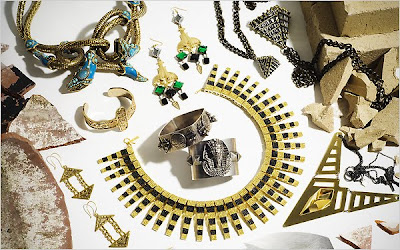
Egyptian JewelryTOMB RAIDERS Clockwise from top left: Lanvin gold and turquoise serpent choker, $2,875 at Barneys New York; Fallon gunmetal and crystal Isis earrings, $150 at Barneys Co-Op; Anndra Neen mixed-metal pyramid pendants, $495 and $550 at kirnazabete.com; TomTom 18-karat gold-plated link necklace with gunmetal chains, $325 at evanewyork.net; Eddie Borgo Step Collar in 18-karat gold plate and black pavé crystals, $1,250 at Bergdorf Goodman; A Peace Treaty handmade antiqued gold-plated bronze earrings, $170 at apeacetreaty.com; Low Luv by Erin Wasson 14- karat gold-plated hieroglyphic cuff, $105 at mywardrobe.com; Fallon oxidized sterling-silver-plated brass Cairo bangle, $170 at Fenton/Fallon, and Tomb cuff, $198 at shopbop.com.

PYRAMIDS, pharaohs, snakes, hieroglyphics and plenty of golden jewels — yep, King Tut is back in town.
Should a childhood fixation with all things ancient Egyptian be rekindled by the arrival of the latest blockbuster Tut exhibition, “Tutankhamun and the Golden Age of the Pharaohs,” now at Discovery Times Square Exposition, we’ve unearthed a trove of cool spring jewelry that would be the envy of a pharaoh.
Two of this year’s nominees for the accessories award that the Council of Fashion Designers of America will bestow next month found their way to Egypt via quite different routes. ...

Nice ice - Diamond jewelry still tops for retailers

source : nationaljewelernetwork.com
By Catherine Dayrit
May 04, 2010

Nice ice

Carla Amorim's "Champagne" ring in 18-karat yellow gold with 1.5 carats of diamonds; suggested retail price is $9,000. CarlaAmorim.com

New York--Despite widespread efforts to reduce inventory, there are some items that jewelers simply must keep in stock.

Diamond hoops and studs, as well as delicate pendants, are can't-go-wrong options for need-it-now customers, while trendy diamond charms and colored diamonds might catch the eye of customers seeking the unique.

Diamond jewelry continues to represent the largest category of sales among jewelry retailers, bar none, thanks in part to a marketing machine matched by no other jewelry category. Credit is also due to innovative new styles--who would have thought rough cuts and brown diamonds would become designer darlings?--offering a welcome retreat from the familiar. ...

Wednesday, April 28, 2010

History of Gold

Gold has a long and complex history. From gold’s first discovery, it has symbolized wealth and guaranteed power. Gold has caused obsession in men and nations, destroyed some cultures and gave power to others.

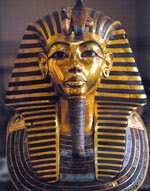
The Golden Mask of Tutankamun

Archaeological digs suggest the use of Gold began in the Middle East where the first known civilizations began. The oldest pieces of gold jewelry Egyptian jewelry were found in the tomb of Queen Zer and that of Queen Pu-abi of Ur in Sumeria and are the oldest examples found of any kind of jewelry in a find from the third millennium BC. Over the centuries, most of the Egyptian tombs were raided, but the tomb of Tutankhamen was discovered undisturbed by modern archaeologists. Inside the largest collection of gold and jewelry in the world was found and included a gold coffin whose quality showed the advanced state of Egyptian craftsmanship and goldworking (second millennium BC).

The Persian Empire, in what is now Iran, made frequent use of Gold in artwork as part of the religion of Zoroastrianism. Persian goldwork is most famous for its animal art, which was modified after the Arabs conquered the area in the 7th century AD.

Gold CoinsWhen Rome began to flourish, the city attracted talented Gold artisans who created gold jewelry of wide variety. The use of gold in Rome later expanded into household items and furniture in the homes of the higher classes. By the third century AD, the citizens of Rome wore necklaces that contained coins with the image of the emperor. As Christianity spread through the European continent, Europeans ceased burying their dead with their jewelry. As a result, few gold items survive from the Middle Ages, except those of royalty and from church hordes.

In the Americas, the skill of Pre-Columbian cultures in the use of Gold was highly advanced long before the arrival of the Spanish. Indian goldsmiths had mastered most of the techniques known by their European contemporaries when the Spanish arrived. They were adept at filigree, granulation, pressing and hammering, inlay and lost-wax methods. The Spanish conquerors melted down most of the gold that they took from the peoples of this region and most of the remaining examples have come from modern excavations of grave sites. The greatest deposits of gold from these times were in the Andes and in Columbia.

During the frontier days of the United States news of the discovery of gold in a region could result in thousands of new settlers, many risking their lives to find gold. Gold rushes occurred in many of the Western States, the most famous occuring in California at Sutter’s Mill in 1848. Elsewhere, gold rushes happened in Australia in 1851, South Africa in 1884 and in Canada in 1897.

The rise of a gold standard was meant to stabilize the global economy, dictating that a nation must limit its issued currency to the amount of gold it held in reserve. Great Brittain was the first to adopt the gold standard in 1821, followed, in the 1870s, by the rest of Europe followed. The system remained in effect until the end of the first world war, after which the US was the only country still honoring the Gold Standard. After the war, other countries were allowed to keep reserves of major currencies instead of gold. The arrival of the great depression marked the end of the U.S. export of gold in the 1930s. By mid 20th century, the US dollar had replaced gold in international trade.
text source : http://bullion.nwtmint.com/gold_history.php

Gold Bars

Sunday, April 11, 2010

Etruscan-inspired gold exhibit sets sail for U.S.

April 08, 2010
goldsmith Akelo's necklaceGold jewelry from Italian master goldsmith Akelo, such as the necklace above, will be on display in a new exhibit opening June 5 in Columbia, Mo.

Columbia, Mo.--Ancient Etruscan-inspired gold jewelry designs will be featured this summer in a first-ever museum exhibition from Italian master goldsmith Andrea Cagnetti, also known as "Akelo."

The exhibition, "The Voyage of a Contemporary Italian Goldsmith in the Classical World: Golden Treasures by Akelo," was conceived and organized by the Museum of Art and Archeology at the University of Missouri in Columbia, Mo., and will open to the public there on June 5.

Akelo creates one-of-a-kind pieces of 22-karat gold jewelry and precious golden objects inspired by the gold designs of the ancient Etruscans, who were known for their fantastic artistry and craftsmanship. The goldsmith's work is based on myths, legends and symbols derived from ancient worlds, which is then rendered in gold via a knowledge of alchemy that is the result of years of in-depth study of ancient and medieval texts.

The exhibition "concentrates on the artist's voyage and ultimate transcendence of the Etruscan, Greek and Roman influences that inspire him as an artist," Mary Pixley, museum curator and exhibition organizer, said in a media release. "Unparalleled technical perfection is married with a timeless classicizing language and the artist's own aesthetic sensibility in Akelo's golden creations."

Saturday, August 2, 2008

Blinged Out Bluetooth

Jewelry.com, 05/12/2008
Blinged Out Bluetooth

If you're not worried about little things such as a mortgage, bills, car payments, the price of gas or what your friends would say, Jewelry.com has found a little Bluetooth headset that might just be what you've never wanted.
Motorola knows that sometimes practicality can get rather staid, so they've thrown diamonds to the wind and come up with a bluetooth that every blinged out millionaire should have. The Motoral Motopure H12 is no ordinary headset. This one is made from either yellow or white gold and covered with 184 diamonds.
The price - a mere $17,000.


Related Posts with Thumbnails