

Sunday, November 25, 2007
Saturday, November 17, 2007
Diamond News : Uncertainty abounds as sightholders anticipate new list
November 16, 2007
By Michelle Graff
New York—The Diamond Trading Co. (DTC) acknowledged on Friday that it is an uncertain time for U.S. diamond dealers as they await the Dec. 12 release of the DTC's updated sightholder list.
Earlier in the week, in response to this uncertainty, the Diamond Manufacturers and Importers Association of America (DMIA) sent a letter addressed to DTC Managing Director Varda Shine underscoring the importance of retaining as many U.S. sightholders as possible.
On Friday, in an e-mail to National Jeweler, the DTC stated that it "understands that this may be a time of uncertainty for some, but we would reassure people that the selection process...doesn't favor anybody."
The DMIA's letter, copied to high-ranking government officials including Secretary of State Condoleezza Rice and New York Sen. Hillary Clinton, included an attachment breaking down the amount of aid the United States supplies to African nations, many of which are the world's top diamond producers.
In its response on Friday, the DTC said it supports producer countries' aspirations to improve local economies in southern Africa. But the response also pointed out that the DTC only supplies a small percentage of N.Y. sightholder requirements, and that the diamonds reserved for polishing in southern African amount to less than 5 percent of world diamond production.
Both the DTC and DMIA President Ronnie Friedman acknowledged that the letter from the DMIA to the DTC was the first of its kind.
In an interview on Thursday, Friedman said that while the DMIA always has communicated with the DTC, the letter marked "the first time we sent a letter like this in this kind of way."
Friedman was unavailable for comment on Friday.
The nine U.S.-based companies currently included on the DTC's sightholder list are: Almod Diamonds Ltd., Dynamic Diamonds Corp., Hasenfeld-Stein Inc., Julius Klein Diamonds LLC, Lazare Kaplan International Inc., Louis Glick Diamond Corp., Michael Werdiger Inc., Premier Gem (Group) and Stuller Inc.
New York—The Diamond Trading Co. (DTC) acknowledged on Friday that it is an uncertain time for U.S. diamond dealers as they await the Dec. 12 release of the DTC's updated sightholder list.
Earlier in the week, in response to this uncertainty, the Diamond Manufacturers and Importers Association of America (DMIA) sent a letter addressed to DTC Managing Director Varda Shine underscoring the importance of retaining as many U.S. sightholders as possible.
On Friday, in an e-mail to National Jeweler, the DTC stated that it "understands that this may be a time of uncertainty for some, but we would reassure people that the selection process...doesn't favor anybody."
The DMIA's letter, copied to high-ranking government officials including Secretary of State Condoleezza Rice and New York Sen. Hillary Clinton, included an attachment breaking down the amount of aid the United States supplies to African nations, many of which are the world's top diamond producers.
In its response on Friday, the DTC said it supports producer countries' aspirations to improve local economies in southern Africa. But the response also pointed out that the DTC only supplies a small percentage of N.Y. sightholder requirements, and that the diamonds reserved for polishing in southern African amount to less than 5 percent of world diamond production.
Both the DTC and DMIA President Ronnie Friedman acknowledged that the letter from the DMIA to the DTC was the first of its kind.
In an interview on Thursday, Friedman said that while the DMIA always has communicated with the DTC, the letter marked "the first time we sent a letter like this in this kind of way."
Friedman was unavailable for comment on Friday.
The nine U.S.-based companies currently included on the DTC's sightholder list are: Almod Diamonds Ltd., Dynamic Diamonds Corp., Hasenfeld-Stein Inc., Julius Klein Diamonds LLC, Lazare Kaplan International Inc., Louis Glick Diamond Corp., Michael Werdiger Inc., Premier Gem (Group) and Stuller Inc.
Saturday, November 10, 2007
Ruby : as a mineral
Ruby is a light pink to blood red gemstone, a variety of the mineral corundum (aluminium oxide). The common red color is caused mainly by the element chromium. Its name comes from ruber, Latin for red. Other varieties of gem-quality corundum are called sapphires. It is considered one of the four precious stones, together with the sapphire, the emerald and the diamond. Improvements used include color alteration, improving transparency by dissolving rutile inclusions, healing of fractures (cracks) or even completely filling them.
Prices of rubies are primarily determined by color (the brightest and best "red" called Pigeon Blood Red, command a huge premium over other rubies of similar quality). After color follows clarity: similar to diamonds, a clear stone will command a premium, but a ruby without any needle-like rutile inclusions will indicate the stone has been treated one way or another. Cut and carat (size) also determine the price.
more about ruby : http://en.wikipedia.org/wiki/Ruby
| Ruby | |
|---|---|
 Ruby crystal before faceting, length 0.8 inches (2 cm) | |
| General | |
| Category | Mineral variety |
| Chemical formula | aluminium oxide with chromium, Al2O3::Cr |
| Identification | |
| Color | Red, may be brownish or purplish |
| Crystal habit | Varies with locality. Terminated tabular hexagonal prisms. |
| Crystal system | Trigonal |
| Cleavage | No true cleavage |
| Fracture | Uneven or conchoidal |
| Mohs Scale hardness | 9.0 |
| Luster | Vitreous |
| Refractive index | ~1.762-1.770 |
| Pleochroism | Orangey Red, Purplish Red |
| Ultraviolet fluorescence | red under longwave |
| Streak | white |
| Specific gravity | 4.0 |
| Melting point | 2050°C |
| Fusibility | perfectly |
| Solubility | none |
| Diaphaneity | transparent |
Tuesday, November 6, 2007
Jewelry Art Awards 2007 of Jewelry Artist Magazine
source : Jewelry Artist
Jewelry Artist is pleased to announce the winners of our 2007 Jewelry Arts Awards. Entries for our sixth annual competition were judged by Todd Reed, a self-taught goldsmith and metalsmith who has been exploring the use of rough diamonds in his award-winning, signature jewelry since 1992; Robert Diamante, a professional photographer who has been photographing jewelry for the craft industry since 1993; and Thomas Mann, a jeweler committed to both the artistic and business sides of jewelry making, who has been active in the contemporary craft movement for more than 30 years.
Congratulations to the winners and our thanks to the judges and everyone who entered.
Jewelry Arts Awards 2007 Winners
Miscellaneous Jewelry
First Place: Daniel M. Nagy - Best of Competition
(also First Place, Miscellaneous Jewelry) Frutto di Mare
14K yellow and white gold 353.5g, 3pcs Tahitian pearls 9mm semi baroque, 2pcs 10.5 round AAA grade 86 pcs, 1.659 ct. brilliant cut diamonds. Wax carved and chased shells, hand cut handpiece, and engraved gemstone buttons. Original electronics only; workable inner part is rebuilt based on design and requirements. 200mm x 80mm x 70mm.
Photo: Arion Kudasz Gabor.

Photo: Arion Kudasz Gabor.
Miscellaneous Jewelry
First Place: Daniel M. Nagy, Frutto di Mare, above.
Second Place: Blue Moon, Marie Scarpa
Maria Scarpa, Second Place
Miscellaneous Jewelry
Blue Moon, 18K gold and platinum, hand fabricated pin/pendant; bezel-set 18mm 7.15ct abalone pearl center and 64 spires divided into 3 levels. Woven, invisibly soldered. Embellished with 28 round faceted 2.0mm pink sapphires, 4 round faceted 2.5mm yellow sapphires, eight round faceted 2.5mm blue sapphires, 4 round faceted 2.9mm blue sapphires, 16 round faceted 3.0mm teal green tourmalines, 4 round faceted 3.5mm teal green tourmalines. Hand fabricated and hand woven. 2.25".
Miscellaneous Jewelry
Blue Moon, 18K gold and platinum, hand fabricated pin/pendant; bezel-set 18mm 7.15ct abalone pearl center and 64 spires divided into 3 levels. Woven, invisibly soldered. Embellished with 28 round faceted 2.0mm pink sapphires, 4 round faceted 2.5mm yellow sapphires, eight round faceted 2.5mm blue sapphires, 4 round faceted 2.9mm blue sapphires, 16 round faceted 3.0mm teal green tourmalines, 4 round faceted 3.5mm teal green tourmalines. Hand fabricated and hand woven. 2.25".

First Place (tied): Dream Catcher, Jeffrey Appling
First Place (tied): Whirlpool, Daniel M. Nagy

Jeffrey Appling, First Place (tied)
Earrings (above)
Dream Catcher, platinum chain, 18K yellow and white gold. Two half-moon diamonds, two 5-point-star diamonds, six natural yellow diamonds, 2mm square and round ruby, blue and yellow sapphire, spessartite, tsavorite, blue/green tourmaline, amethyst, two half-moon drusy onyx tablets. Cast manufacture, hand fabrication, bezel, tube, bead, and mock (bead) setting for cubes. 62mm x 26.5mm.
Photo: Hap Sakwa.
Daniel M. Nagy. First Place (tied)
Earrings
Whirlpool, 18K white gold, 15.5g. Tahitian pearl AAA, 10mm round 2pcs. Computer designed, wax printed, chased, hand finished. 120mm x 20mm x 20mm.
Photo: Daniel M. Nagy.


Jeffrey Appling, First Place
Rings (above)
Pearl Protrusion, 950 platinum, 8.5mm faceted black cultured pearl and 8.5mm faceted white cultured pearl, tsavorite garnets and pink sapphires. Hand carved wax and of cast manufacture, bead-set small round gemstones and hand carved (artwork) along outside borders. 10.5mm x 20mm. Photo: Hap Sakwa.
 Daniel M. Nagy & Agnes Kertesz, Second Place
Rings (above)
Message, 18K white gold 10.8g, Tahitian pearl AAA round 1pc 9.4mm, brilliant cut diamonds. 20mm x 15mm.

Laura Parr, First Place
Bracelets (above)
Salad Blues, forged and riveted sterling silver sheet, wire, tube, copper sheet; ten 1.5 millimeter, tube-set and riveted sapphires; ink. 51mm x 82mm x 72mm.
Photo: Jeremy Addington.


Dmitriy Pavlov, Second Place
Bracelets (above)
Dragon of 4 Elements, pierced, bent, and engraved sterling silver. 51mm x 82mm x 72mm.
Photo: Galina Pavlova.

Tricia Lachowiec, First Place
Pins/Brooches (above)
Inception, 18K gold on sterling silver, copper, enamel, diamond, steel. Chasing and repoussé, enameling. 23⁄4" x 1-5⁄8" x 3⁄4".
Photo: Dean Powell.
 Wendy McAllister, Second Place
Pins/Brooches (above)
Star, sterling silver, acrylic, lenticular lens, 24K gold leaf, fabricated silver brooch, fabricated double pinstem back; found objects: candle bobeche and child’s ruler. 3.5".
Photo: Ralph Gabriner.

Mary Darwall, First Place
Pendants/Necklaces (above)
Eleven turquoise cabochons, turquoise beads, freshwater pearls, glass seed beads, beading cloth, nylon thread, 49-strand wire, 14K closure, leather backing. Hand needle woven, bead appliqué, freeform peyote, branching stitches. 18".
Photo: John Yohman.
 Jeffrey Appling, Second Place (tied)
Pendants/Necklaces (above)
Evolution, 30.37ct drilled citrine intruded with malachite, coral, and lapis tubes, 3.66cts. Drilled-out citrine pavilion injected with gemstones, pendant area cast, and hand fabricated. 16", 30.5mm x 33mm.
Photo: Hap Sakwa.

Tricia Lachowiec, Second Place (tied)
Pendants/Necklaces (above)
Fruit, oxidized sterling silver, electroformed copper, enamel, 14K gold, cognac diamonds, sapphires. Electroforming and enameling. 10" x 6-1⁄4" x 1-1⁄4".
Photo: Dean Powell.
source : Jewelry Artist
Earrings
Whirlpool, 18K white gold, 15.5g. Tahitian pearl AAA, 10mm round 2pcs. Computer designed, wax printed, chased, hand finished. 120mm x 20mm x 20mm.
Photo: Daniel M. Nagy.

First Place: Pearl Protrusion, Jeffrey Appling
Second Place: Message, Daniel M. Nagy and Agnes Kertesz

Jeffrey Appling, First Place
Rings (above)
Pearl Protrusion, 950 platinum, 8.5mm faceted black cultured pearl and 8.5mm faceted white cultured pearl, tsavorite garnets and pink sapphires. Hand carved wax and of cast manufacture, bead-set small round gemstones and hand carved (artwork) along outside borders. 10.5mm x 20mm. Photo: Hap Sakwa.
 Daniel M. Nagy & Agnes Kertesz, Second Place
Rings (above)
Message, 18K white gold 10.8g, Tahitian pearl AAA round 1pc 9.4mm, brilliant cut diamonds. 20mm x 15mm.
Bracelets
First Place: Salad Blues, Laura Parr
Second Place: Dragon of 4 Elements, Dmitriy Pavlov

Laura Parr, First Place
Bracelets (above)
Salad Blues, forged and riveted sterling silver sheet, wire, tube, copper sheet; ten 1.5 millimeter, tube-set and riveted sapphires; ink. 51mm x 82mm x 72mm.
Photo: Jeremy Addington.


Dmitriy Pavlov, Second Place
Bracelets (above)
Dragon of 4 Elements, pierced, bent, and engraved sterling silver. 51mm x 82mm x 72mm.
Photo: Galina Pavlova.
Pins & Brooches
First Place: Inception, Tricia Lachowiec
Second Place: Star, Wendy McAllister

Tricia Lachowiec, First Place
Pins/Brooches (above)
Inception, 18K gold on sterling silver, copper, enamel, diamond, steel. Chasing and repoussé, enameling. 23⁄4" x 1-5⁄8" x 3⁄4".
Photo: Dean Powell.
 Wendy McAllister, Second Place
Pins/Brooches (above)
Star, sterling silver, acrylic, lenticular lens, 24K gold leaf, fabricated silver brooch, fabricated double pinstem back; found objects: candle bobeche and child’s ruler. 3.5".
Photo: Ralph Gabriner.
Pendants & Necklaces
First Place: Mary Darwall
Second Place (tied): Evolution, Jeffrey Appling
Second Place (tied): Fruit, Tricia Lachowiec

Mary Darwall, First Place
Pendants/Necklaces (above)
Eleven turquoise cabochons, turquoise beads, freshwater pearls, glass seed beads, beading cloth, nylon thread, 49-strand wire, 14K closure, leather backing. Hand needle woven, bead appliqué, freeform peyote, branching stitches. 18".
Photo: John Yohman.
 Jeffrey Appling, Second Place (tied)
Pendants/Necklaces (above)
Evolution, 30.37ct drilled citrine intruded with malachite, coral, and lapis tubes, 3.66cts. Drilled-out citrine pavilion injected with gemstones, pendant area cast, and hand fabricated. 16", 30.5mm x 33mm.
Photo: Hap Sakwa.

Tricia Lachowiec, Second Place (tied)
Pendants/Necklaces (above)
Fruit, oxidized sterling silver, electroformed copper, enamel, 14K gold, cognac diamonds, sapphires. Electroforming and enameling. 10" x 6-1⁄4" x 1-1⁄4".
Photo: Dean Powell.
source : Jewelry Artist
Thursday, November 1, 2007
Emerald : as a mineral
| Emerald | |
|---|---|
 Emerald with host rock | |
| General | |
| Category | Silicate mineral |
| Chemical formula | Beryllium aluminium silicate with chromium, Be3Al2(SiO3)6::Cr |
| Identification | |
| Color | Green |
| Crystal habit | Hexagonal Crystals |
| Crystal system | Hexagonal |
| Cleavage | Poor Basal Cleavage (Seldom Visible) |
| Fracture | Conchoidal |
| Mohs Scale hardness | 7.5 - 8.0 |
| Luster | Vitreous |
| Refractive index | 1.576 - 1.582 |
| Pleochroism | Distinct, Blue-Green/Yellow-Green |
| Streak | White |
| Specific gravity | 2.70 - 2.78 |
Properties determining value
Emeralds come in many shades of green and bluish green. There is a wide spectrum of clarity, dependent on the inclusions and fractures in the crystal. Clear stones with dark yet vibrant color command the highest prices. Almost all emeralds contain numerous flaws, cracks, and inclusions, which can negatively affect the clarity. These are given the name "jardin", from the French word for garden. The value of an emerald depends on cut, color, clarity, and carat. Currently the best emeralds come from the Muzo mine in Colombia.
Treatments
Most emeralds are oiled as part of the post lapidary process, in order to improve their clarity. Cedar oil, having a similar refractive index, is often used in this generally accepted practice. The U.S. Federal Trade Commission requires the disclosure of this treatment when a treated emerald is sold.The amount of oil entering an emerald microfissure is roughly equivalent to the size of a period (full stop) in print[citation needed]. The use of green-tinted oil is generally not considered acceptable by the gem trade.
Emerald localities
Emeralds in antiquity were mined by the Egyptians and in Austria, as well as Swat in northern Pakistan.
A rare type of emerald known as a trapiche emerald is occasionally found in the mines of Colombia. A trapiche emerald exhibits a "star" pattern; it has raylike spokes of dark carbon impurities that give the emerald a six-pointed radial pattern. It is named for the trapiche, a grinding wheel used to process sugarcane in the region. Colombian emeralds are generally the most prized due to their transparency and fire. Some of the most rare emeralds come from three main emerald mining areas in Colombia: Muzo, Coscuez, and Chivor. Fine emeralds are also found in other countries, such as Zambia, Brazil, Zimbabwe, Madagascar, Pakistan, India, Afghanistan and Russia. In the US, emeralds can be found in North Carolina. In 1998, emeralds were discovered in the Yukon, Canada .
Synthetic emerald
 Emerald showing its hexagonal structure
 Emerald is a rare and valuable gemstone and, as such, it has provided the incentive for developing synthetic emeralds. Both hydrothermal and flux-growth synthetics have been produced, and a method has been developed for producing an emerald overgrowth on colorless beryl. The first commercially successful emerald synthesis process was that of Carroll Chatham. Because Chatham's emeralds do not have any water and contain traces of vanadate, molybdenum and vanadium, a lithium vanadate flux process is probably involved. The other large producer of flux emeralds is Pierre Gilson Sr., which has been on the market since 1964. Gilson's emeralds are usually grown on natural colorless beryl seeds which become coated on both sides. Growth occurs at the rate of 1 mm per month and a typical seven-month growth run produces emerald crystals of 7 mm of thickness (Nassau, K. Gems Made By Man, 1980).
Hydrothermal synthetic emeralds have been attributed to IG Farben, Nacken, Tairus and others, but the first satisfactory commercial product was that of Johann Lechleitner of Inbruck, Austria, which appeared on the market in the 1960s. These stones were initially sold under the names "Emerita" and "Symeralds", and they were grown as a thin layer of emerald on top of natural colorless beryl stones. Although not much is known about the original process, it is assumed that Leichleitner emeralds were grown on acid conditions. Later, from 1965 to 1970, the Linde Division of Union Carbide produced completely synthetic emeralds by hydrothermal synthesis. According to their patents (US3,567,642 and US3,567,643), acidic conditions are essential to prevent the chromium (which is used as the colorant) from precipitating. Also, it is important that the silicon containing nutrient be kept away from the other ingredients in order to prevent nucleation and confine growth to the seed crystals. Growth occurs by a diffusion-reaction process, assisted by convection. Typical growth conditions include pressures of 700-1400 bars at temperatures of 500 to 600 °C with a temperature gradient of 10 to 25 °C. Growth rates as fast as 1/3 mm per day can be attained[citation needed]
Luminescence in ultraviolet light is considered a supplementary test when making a natural vs. synthetic determination, as many, but not all, natural emeralds are inert to ultraviolet light. Many synthetics are also UV inert.
Synthetic emeralds are often referred to as "created", as their chemical and gemological composition is the same as their natural counterparts. The U.S. Federal Trade Commission (FTC) has very strict regulations as to what can and what cannot be called "synthetic" stone. The FTC says: "§ 23.23(c) It is unfair or deceptive to use the word "laboratory-grown," "laboratory-created," "[manufacturer name]-created," or "synthetic" with the name of any natural stone to describe any industry product unless such industry product has essentially the same optical, physical, and chemical properties as the stone named."
Wispy veil-like inclusions are common in flux-grown synthetic emeralds.
Emerald in different cultures, and Emerald lore
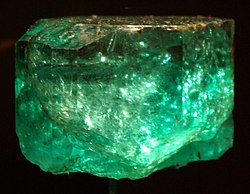

Emerald is regarded as the traditional birthstone for May, as well as the traditional gemstone for the astrological signs of Taurus and Cancer. One of the more quaint anecdotes on emeralds was by the 16th century historian Brantome, who referred to the many impressive emeralds the Spanish under Cortez had brought back to Europe from Latin America. On one of Cortez most famous emeralds he had the text engraved Inter Natos Mulierum non sur-rexit mayor (Among them borne of woman there hath not arisen a greater Man. XI, 11) which referred to John the Baptist. Brantome considered engraving such a beautiful and simple product of nature sacrilegious and considered this act the cause for Cortez loss of an extremely precious pearl (to which he dedicated a work A beautiful and incomparable pearl) and even for the death of King Charles IX who soon died after.
High Priest Breastplate
In Exodus chapters 28 and 39, a number of precious stones are mentioned to be placed in the High Priest's Breastplate, representing the different tribes of Israel. This is generally considered to be (one of) the origin(s) for our present day tradition of birthstones.
According to Rebbenu Bachya, and the King James Version, the Hebrew word Nofech in Exodus 28:18 means Emerald, and was the stone on the Hoshen representing the tribe of Judah. However, the Septuagint translates the word as Anthrax, meaning coal, probably in reference to the colour of burning coal, and therefore many rabbinical sources, and most scholars, consider Nofech to mean a red garnet – traditionally called a carbuncle, which happens to be the Vulgate's translation of the word. There is a wide range of views among traditional sources about which tribe the stone refers to.
There are many complexities to identifying the Emerald as being the third stone or perhaps another stone on the breast plate. Multiple translations of the bible have created confusion about the nomenclature of the different stones. Another important fact is that in actuality there are 2 different breastplates made within a period of 800 years, and where it is assumed the first breastplate did not carry an Emerald but a green Felspar, and a real Emerald in the second breastplate. Finally the 12th stone in the Breastplate (which in the original text was actually listed as the 6th stone) has more generally been identified as Beryl which was already included in the group of stones generally referred to as Smaragdus by Theophrastus in the Greek era. . Further unreferenced claims regarding the possibility of what gemstone the Emerald could really have been include Jasper, and even Rubies.
In some cultures, the emerald is the traditional gift for the 55th wedding anniversary. It is also used as a 20th and 35th wedding anniversary stone.
Famous emeralds
- Gachala Emerald (origin: Colombia)
- Chalk Emerald (origin: Colombia)
- Nidvin Emerald (origin: Colombia)
- Duke of Devonshire Emerald (origin: Colombia)
- Mackay Emerald
- Greenshorkire Emerald
- Edward the Confessor Emerald in the Imperial State Crown of Great Britain
Subscribe to:
Posts (Atom)


